
Scientists spend up to 25% of their working hours on manual inventory upkeep, and 90% still struggle to find the storage location of consumables even when a tracking system is already in place. That's not a minor inefficiency. It's a quarter of a highly trained researcher's week spent looking for things instead of doing science, and it's one of the most fixable problems in a modern lab.
What poor inventory management costs
The financial exposure is bigger than most labs budget for. Facilities report disposing of a median of $500 worth of expired chemicals every month, then spending another $300 monthly just to get rid of them, with some larger operations spending upward of $100,000 a month on disposal. Roughly 17% of surveyed respondents lose at least 10% of their inventory monthly to spoilage and expiration, and nearly a quarter of labs report being unable to run a scheduled experiment about 10% of the time because a needed material simply wasn't there.
The time cost compounds the financial one. It can take up to 50 minutes to locate a single sample, and 70% of labs cite the lack of real-time, automatic updates on reagent status and location as their single biggest inventory problem. In some documented cases, scientists were spending 45 minutes per day per person on inventory-related searches; across a 30-person lab, that's roughly 200 hours a week that could have gone to actual research instead.
The five steps that actually fix this
1. Conduct an inventory audit. Before implementing any system, take stock of everything in the lab, chemicals, consumables, and equipment, and categorize it accurately. This isn't a one-time chore. It's what reveals which items need frequent restocking and which have longer shelf lives, and it's usually the point where labs discover just how much of their existing inventory doesn't match what's actually on the shelf.
2. Set up an inventory management system. Spreadsheets work at small scale but break down fast; purpose-built LIMS or dedicated inventory software track usage and location, trigger low-stock alerts, and generate reports for ordering and budgeting automatically. The system needs to answer a simple test: if it's not in the system, it shouldn't exist for ordering purposes, and every item entering the lab should be scanned in before it goes anywhere near a shelf or freezer.
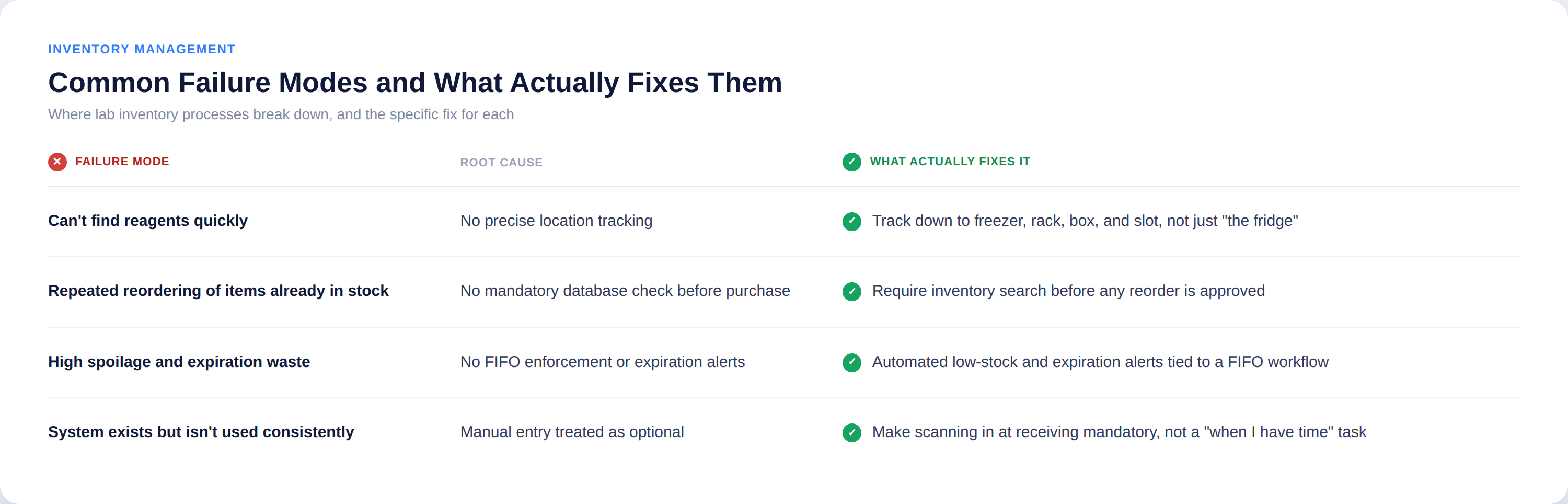
3. Label everything with precision, not just a name. A unique identifier, whether a barcode or QR code, paired with concentration, expiration date, and other relevant details, is what separates a fast retrieval from a 20-minute search. The most effective labs track location down to the exact position: which freezer, which rack, which box, which slot, not just "somewhere in the -80."
4. Implement a first-in, first-out (FIFO) system. Placing new stock behind existing inventory ensures older materials get used before they expire, directly reducing the spoilage rate that drains lab budgets every month. This is also where regular audits catch expired items before they become a safety or compliance issue rather than after.
5. Monitor usage and set up reordering triggers. Regular tracking of consumption patterns identifies what needs reordering and when, preventing both stockouts that delay experiments and overordering that leads right back to expired, wasted stock.
Why this keeps happening even with a system in place
The uncomfortable finding across multiple industry surveys is that having some kind of inventory system doesn't automatically solve the problem. Fewer than half of surveyed lab staff report using purpose-built inventory software at all, and of those that do, only 37% describe themselves as satisfied with it. Manual data entry remains the default even in labs with a system nominally in place, and 54% of respondents cite recording inventory as a major weekly burden.
The pattern that separates labs that actually fix this from labs that don't isn't the software itself. It's whether the workflow makes the system the single source of truth: receiving is treated as a mandatory step before storage, not an afterthought; searching the database happens before any reagent request is approved; and zones have assigned owners with audits on a fixed schedule rather than left to chance.
What good inventory management actually enables
The payoff isn't just avoided waste. Labs that get this right report staff time on inventory tasks dropping by 35 to 40%, and search time for a specific reagent falling from 45 minutes a day to under 5. That reclaimed time doesn't show up on an invoice, but it shows up in the number of experiments a lab can actually run in a quarter.
The labs that stop losing a quarter of their week to inventory searches aren't the ones with the fanciest software. They're the ones that made the system the only place anyone looks, and enforced that rule without exceptions.
.png)
.png)
.png)
